
Why Local Operators Will Win the Next Economy
The most sophisticated business operators I've ever worked with aren't in Silicon Valley. They run paving companies. Wine shops. Regional gym chains.
They built something most venture-backed founders never will: a business that actually serves real people, in a real community, day after day. Through craft, grit, and an almost irrational level of care. Not a pitch deck. Not a press release.
This is what I believe about them. And why I bet my career on Main Street.
→ Listen to the private podcast — I go deep on systems, constraints, and the real cost of running a business that depends entirely on you.
Why Local Operators Are the Most Important Entrepreneurs Alive
Local operators are the connective tissue holding communities together — and in a fractured world, that makes them irreplaceable.
The contractor who shows up and does what they said they'd do. The gym owner who knows your name. The family-run supply company that calls you back on a Saturday. That's not just good service — that's a proof of concept most corporations have completely abandoned.
Corporations optimized for extraction so long they forgot the point was to serve. Main Street operators never did. Their customer relationship is the asset. Their reputation is the business model.
That orientation wins. It always has. And in an AI arms race where everything is getting more automated and more generic — the human part becomes the edge. Main Street never lost it.
What Do Local Business Owners Actually Get Right?
Local operators measure success by whether the work was done right — not just whether the margin held.
This is why I do this work. Not to bolt enterprise frameworks onto businesses that don't need more complexity. The orientation is right. The systems just need to catch up.
There's a reason I think about this in terms of three forces — Customer Reality, Delivery Reality, Business Reality — what I call the Operator Triangle. The operators I respect most are already running this diagnostic in their heads every day. They're just doing it without the language, without the data, and often without enough distance from the chaos to act on what they already know.
Are Local Operators as Sophisticated as Corporate Executives?
Yes — in ways business culture has consistently undervalued. Local operators are masters of craft, customer intuition, and community dynamics.
They read a job site the way a chess player reads a board. They know which customers are worth the headache and which ones aren't. They've built something that delivers real value to real people, often for decades.
The one layer most operators haven't needed to own — until now — is systems. That's changing fast. The operators who get there first are going to be untouchable. Not because systems are some magical unlock, but because the combination of deep craft plus operational clarity is nearly impossible to compete with.
Does Enterprise Systems Thinking Actually Work for Small Businesses?
Yes. The same three questions that drove product decisions at Uber work just as well for a paving company or a climbing gym.
At Uber and Instacart, everything came back to three questions:
Customer Reality: Do people actually want this?
Delivery Reality: Can we actually deliver it?
Business Reality: Does the math actually work?
Any owner-operator worth their salt is already asking these — just not out loud, not with data, and rarely with enough breathing room to act on the answers clearly.
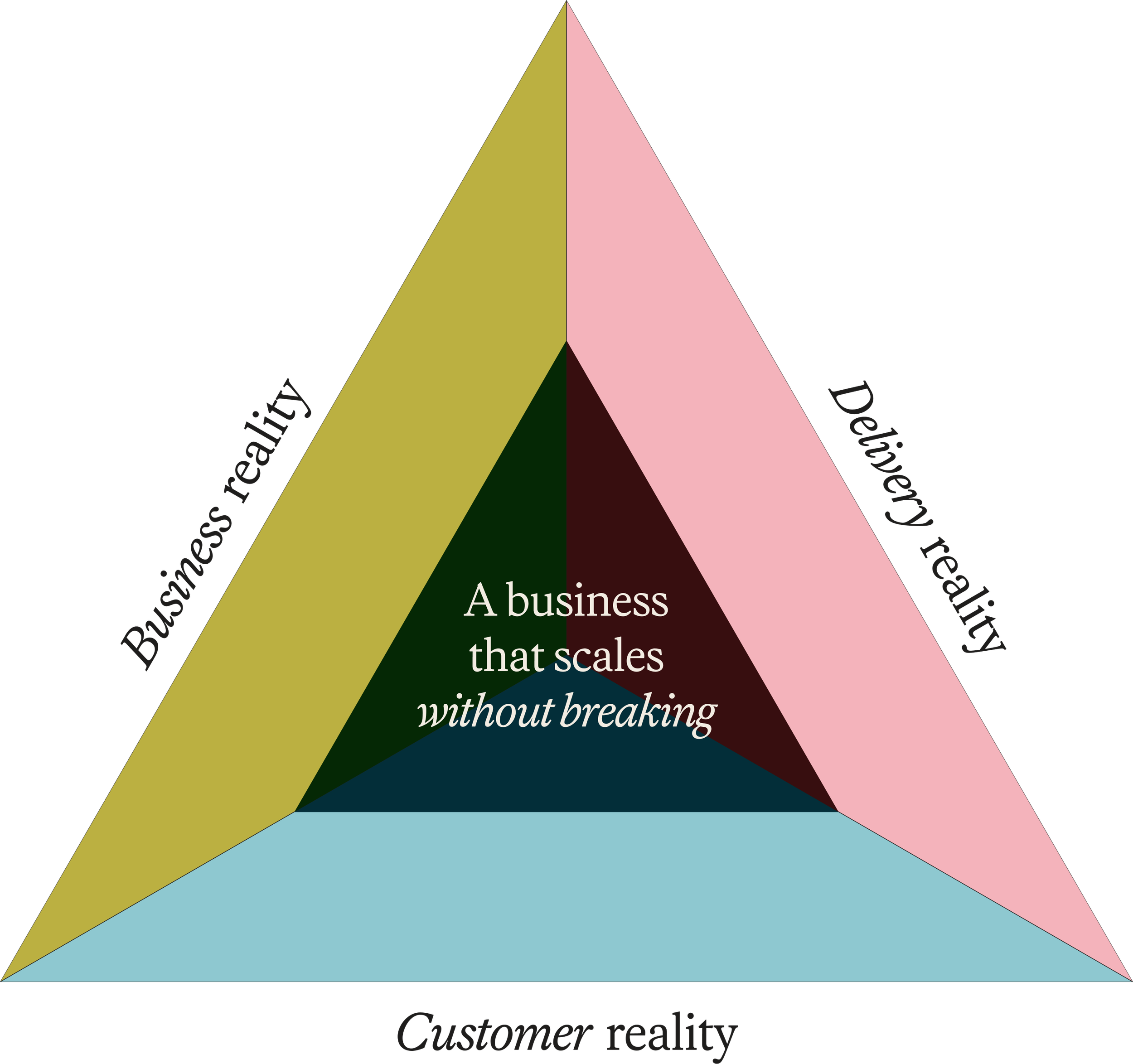
The Operator Triangle isn't dumbed-down product thinking. It's product thinking finally applied to the businesses that need it most. When all three sides align, the business scales without breaking. When they don't — and they often don't — you get firefighting, margin leaks, and that particular kind of exhaustion that comes from being the only person who knows how anything works.
→ Book an Assessment Call to identify what’s holding your business back
Is the Technology Gap Between Big Business and Small Business Closing?
Yes. LLMs have collapsed the advantage that used to require a six-figure tech stack — and most local operators don't know it yet.
Enterprise software was always just a wrapper around a database. A $50,000-a-year visibility layer built to answer one question: what's the status?
Large language models blew that open.
A small operator can now access their own data, build their own workflows, and run with the same operational intelligence that used to require a VP of Ops and a team of analysts. The asymmetry is collapsing, fast.
I'll be honest — the new dependency on the model layer creates its own questions. Workflows are portable, which is genuinely interesting. What that means long-term, I'm still figuring out. But the opportunity for Main Street right now? It's real. And most operators are asleep at the wheel on it.
Why Does Owner Intuition Become a Growth Trap?
Gut instinct is a legitimate asset — until it's your only system. At that point, the business can't move without you in the room.
The owner-operator's gut got them here. It works. Most local service businesses run better margins than venture-backed Series B startups — let that sink in. The intuition is good.
The problem is that gut-driven decision-making requires the owner present for every call, every judgment, every fire. That's the bottleneck. That's what turns a successful business into something that feels more like a sentence than a choice.
The fix isn't to replace the gut. It's to prove what the gut already knows — so the business can act on it without the owner standing there. Run the business like an experiment. Capture what works. Build the system around it.
That's the identity shift underneath all of this: from doer to leader to designer of systems. It doesn't happen in a week. But it's the only path out.
Can Local Business Owners Actually Beat Private Equity?
Yes. An operator running tight systems, real retention, and honest margins doesn't need to sell to survive — they can outrun the roll-up.
The PE playbook isn't complicated: acquire Main Street businesses, apply basic systems, squeeze margin, exit. It works primarily because most local operators haven't built those systems yet. That's the gap PE is buying.
An operator who closes that gap first? Who retains customers, runs clean, and gives a damn about the work?
They don't need the exit to prove value. They can outperform the PE-backed competitor down the street — because they actually care about the work, the people, and the community. You can beat PE at their own game without gutting the soul.
That's not a small thing.
→ Start with a Priority Mapping Call — 15 minutes with our team
Does Growing a Business Mean Sacrificing Everything Else?
No. The hustle-and-sacrifice narrative is a lie that benefits the people selling the hustle.
I say this as someone who watched the grind-culture religion up close in tech. It's not a badge. It's a design failure.
You can build something meaningful without it consuming your whole life. Growth and a real life. Ambition and presence. Scale and sanity. These aren't opposites — they just require the right systems.
The operators I most respect aren't the ones logging 80-hour weeks and calling it discipline. They're the ones who built leverage. Who designed their business so it could run without them in every single room. Who could take a real vacation without the whole thing unraveling.
Both/and. Not either/or. That's the design principle underneath everything I do.
Main Street Is the Advantage
Local operators are not behind. They're not less sophisticated. They're not playing catch-up to enterprise.
They're sitting on the most defensible, community-rooted, relationship-driven businesses in existence. The craft is real. The reputation is real. The customer loyalty is real. The one piece missing — the systems layer to protect and scale all of it — is learnable. Buildable. Not as hard as it looks from inside the chaos.
That's the work. And it's worth doing.
→ Not sure where to start? Grab the free Profit Leaks Field Guide
Or get the weekly newsletter — systems thinking for operators who are done winging it
Frequently Asked Questions
What is the owner-operator bottleneck? It's when the business can only function if the owner is present for every key decision, approval, or problem. Revenue and growth are capped by the owner's hours.
How do local businesses compete with larger companies? By combining genuine relationships, craft, and community trust with basic operational systems. These are advantages large competitors have systematically traded away.
What is the Main Street Operator Triangle? It's a diagnostic framework examining three forces: Customer Reality (what clients expect), Delivery Reality (what your team can execute), and Business Reality (what works financially). When all three align, growth becomes predictable.
Can AI tools actually help local service businesses? Yes. LLMs have collapsed the cost of accessing operational intelligence. A small operator can now build workflows, analyze their own data, and create internal tools that used to require a six-figure tech stack. Wanna chat about what that looks like for your business? Book time with our team here.