
Automate Follow-Up Without Losing Repeat Customers
A customer doesn't come back, and most owners never find out why.
It's usually not the work. The system got serviced, the appointment happened, the job closed out clean. What's missing is everything after — the check-in nobody made, the rebooking nobody chased, the small complaint that turned into a quiet exit because it sat in an inbox for a week while the crew was slammed.
That gap is follow-up. In a service business, follow-up isn't a nicety you get to when things are slow. It's the line between a customer who books once and a customer who books for years and hands you three neighbors.
Owners know the gap is there. A lot of them won't close it with automation anyway, and for a reason worth respecting: their service is personal. People hire them precisely because they're not the big faceless company that never calls back. Automating the follow-up can feel like turning into the thing they beat.
I understand the fear. I think it's pointed at the wrong target. It assumes follow-up is one thing — keep it human, or hand it to a robot. It's two things. One of them is your edge. The other is overhead you're already dropping on the floor.
Why do service customers really leave?
Most leave over a follow-up that never happened, not a service that failed. The work was fine. The relationship went cold after the truck / agent / crew pulled out of the driveway.
This is why it stays invisible. A blown job generates a phone call you can't ignore. A missing follow-up generates nothing at all, just a customer who drifts to whoever remembered to stay in touch. You feel the lost revenue eventually, but you never trace it back to the rebooking text that didn't go out.
The Operator Triangle puts a name on it: the collision between Customer Reality, what they expected to feel as your customer, and Delivery Reality, what actually happened once the invoice was paid. Where those two miss each other, you get churn. Follow-up is the seam right between them, and it's usually the seam nobody owns.
Should a service business automate customer follow-up?
Yes — the operational half of it. The reminders, the status updates, the rebooking nudges, the review requests. Keep the judgment, the recovery, and the relationship in human hands.
The "your tech is on the way" text is overhead. Automate it. Nobody wants you typing that by hand, and nobody feels warmer because you did. The call after a job went sideways is your edge, and a customer can tell inside of four seconds whether a person or a script is apologizing to them.
So the rule isn't automate or don't. Don't automate your edge, and automate enough of everything around it that you actually have time to spend on the edge.
How do you tell the edge from the overhead?
Ask one question of every touchpoint: would the customer feel the absence of you, specifically? If a tool could handle it and nobody would notice, it's overhead. If they'd feel the warmth drain out the second it went robotic, that's your edge, and it stays yours.
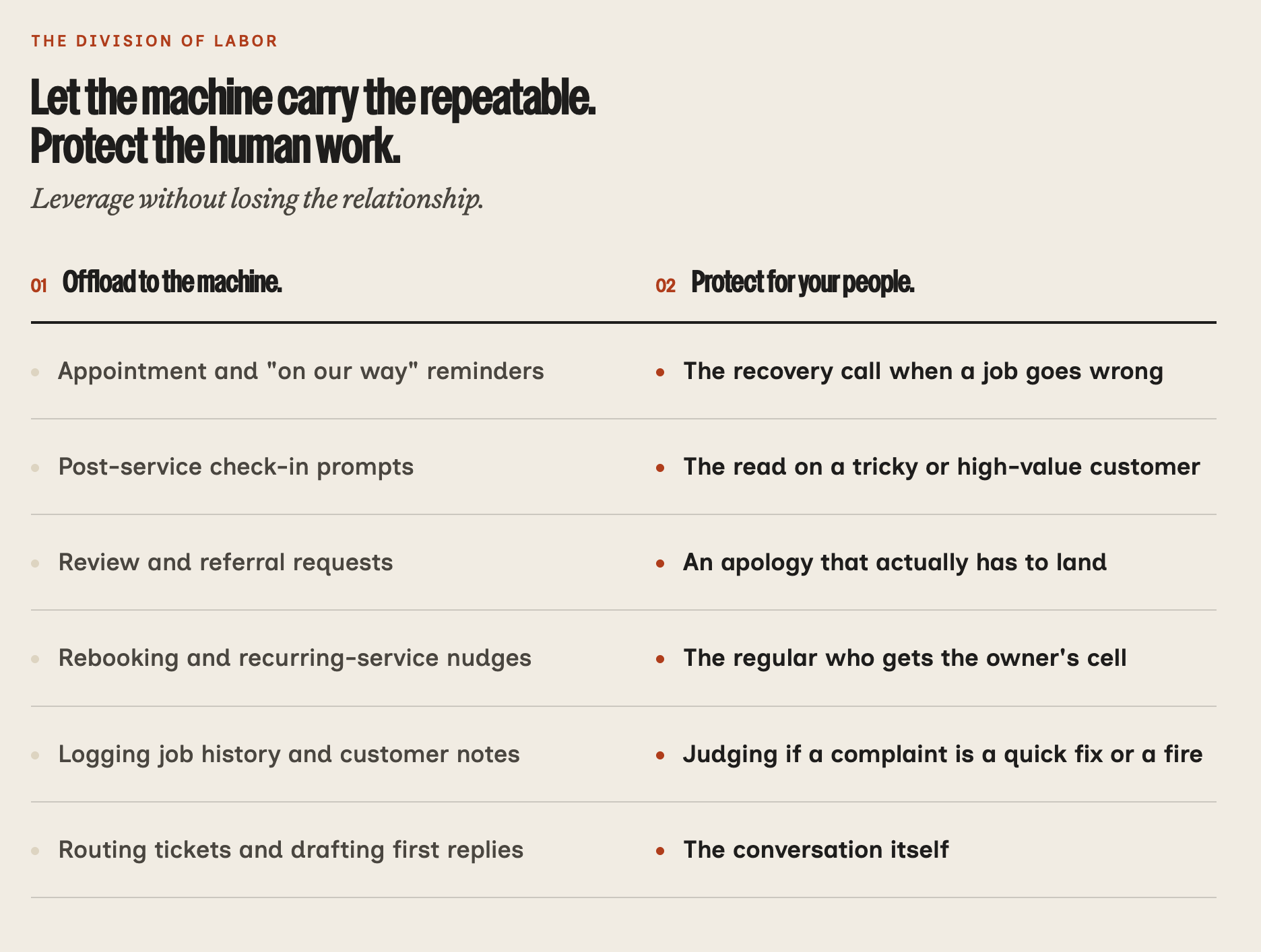
The left column is what you'd hand a great operations coordinator. The right column is the reason customers stay. AI is the coordinator. It is not the reason they stay.
Where does follow-up automation go wrong?
Two ways, mostly. Owners automate the relationship instead of the admin, a "we value your business!" template blasted at someone who came for a human being. And they automate before they've mapped the work.
The first one backfires fast. A canned "how did we do?" landing in the inbox of a customer who just had a bad experience doesn't read as efficient. It reads as nobody's paying attention. That's lazy AI: a tool bolted onto a process you never cleaned up, pointed at your whole list, spraying.
The second is more common. A service business doesn't have a follow-up. It has several — the post-job check-in, the recurring rebook, the complaint, the warranty callback, the review ask. Different triggers, different stakes, different right answers. Run them as one automated blast and you'll pester your best customers while undercooking the ones who needed a person. You can't automate a workflow you've never written down, and most owners never have.
How do you build follow-up that still feels personal?
Start with your people. Put the machine in the middle. End with your people. The system absorbs the volume; your team keeps the handful of moments that decide whether someone comes back. Five stages, in order.
1. Start with what your team already does well. The tech who remembers the dog's name. The office manager who hears stress in someone's voice and walks it over to the owner. Name those instincts before you touch a tool — they're the standard the system has to serve, not the thing it replaces.
2. Get the customer data clean. Job history, service cadence, who's a VIP, who's had a problem before. A reminder that ignores a customer's last bad visit isn't efficient — it's a second insult. Encode the context once so everything downstream respects it.
3. Map the journeys. Post-job check-in. Recurring rebook. Complaint. Warranty callback. Review ask. Write the path for each one: trigger, timing, what gets said, who decides. This is exactly what an AI Strategy Audit produces — a mapped workflow and a build spec, not a slide deck.
4. Automate the overhead. Reminders, status texts, rebooking nudges, review requests, ticket routing, a solid first-draft reply. The repetitive, time-sensitive work that's first to fall through the cracks the minute the crew gets busy.
5. Hand the moments to your people. A complaint routes to a human, with the history already attached — not to an auto-responder. The save, the apology, the call to the account that matters: those reach a person every time, by design.
Then run a measurement loop over the whole thing. Repeat-booking rate. Review volume. How fast complaints actually get resolved. Customers who came back. If the automated touches ever start outscoring the human ones on satisfaction, you've automated too far — pull the line back toward your people.
What to do this week
You don't need a vendor yet. You need an hour and an honest list.
Write down every place a customer can slip through after the sale. Name the journeys.
Sort each touchpoint into two columns: Offload or Protect.
Flag your VIPs and your past-problem customers in whatever system you already use. One pass.
Take the journey you lose the most customers to — usually the post-job check-in or the complaint — and map just that one, end to end.
Get the thinking clean first. The automation is the easy part once you've sorted what's yours to keep. Bolt it onto a messy process and all you've built is a faster way to lose customers with better open rates.
The owner who's scared to automate her follow-up usually isn't protecting the personal touch. She's protecting the story that she's still giving it — while the check-ins go unmade and her good customers quietly try someone who calls back. The personal touch was never the work you refuse to systematize. It's the work you finally have room for once the system carries the rest.
So pull your last ten customers who didn't rebook. Which ones left because your service failed — and which ones left because your follow-up did?
Want the map before you build? That's the AI Strategy Audit: we journey-map your customer follow-up, sort what's edge from what's overhead, and hand you a build spec your team can run. Start here.